Who is the most confident person you know?
Who’s the most confident person I know?
History has plenty to choose from. But there’s one I should say stands out tall among all.
He was the most revered and is kept dear to the hearts of people in Tamilnadu, India. And he was loved by people around the world alike.
Who’s he?
The year 1543, saw the birth of ‘De revolutionibus orbium coelestium’ (On the Revolutions of the Heavenly Spheres) by Nicolaus Copernicus. The mathematician-astronomer questioned the theory of the geocentric model of Ptolemy, who the Catholic Church considered ‘numero uno’.
While Ptolemy positioned Earth at the centre of the universe, Copernicus rebelled and said that the Sun is at the centre of the universe. He was penalized and asked to recant.
Then Galileo Galilei came in 1564. The Father of Observational Astronomy championed the cause of Copernican heliocentrism.
And he met (as usual) with opposition from the Catholic Church. He didn’t stop though.
The Roman Inquisition called Galileo foul in 1615 and termed him foolish, absurd and heretical.
There’s more.
Then came the Age of Enlightenment, or more precisely, the Age of Reason in Europe in the 17th and 18th centuries. That set the tone for a secular world.
Human happiness, pursuit of knowledge through reason, evidence of the senses, were central to this new reasoning movement.
Followed soon were the ideals such as natural law, liberty, progress, toleration, fraternity, constitutional government, and most importantly, a spark that called for the separation of church and state.
John Locke wrote “cogito, ergo sum” (I think, therefore I am) in 1637.
Issac Newton’s Principia Mathematica in 1687 gave birth to the Scientific Revolution in Western Europe.
Immanuel, the father of ethics, aesthetics, and modern philosophy wrote an essay titled ‘Answering the Question: what’s enlightenment?’
Louis XIV died in 1715. The French Revolution began in 1789. Monarchy died a slow death.
A variety of 19th century movements have set the tone for liberalism, socialism and neoclassicism.
Political revolutions have been the order of the day, and they have begun to question the religious authority in power.
People looked with awe at the works of Francis Beacon, Thomas Hobbes, John Locke, David Hume, Kant, Montesquieu, Jean Jacques Rousseau, Adam Smith and Voltaire.
All set. And then an idea was born in 1879 in the South of India.
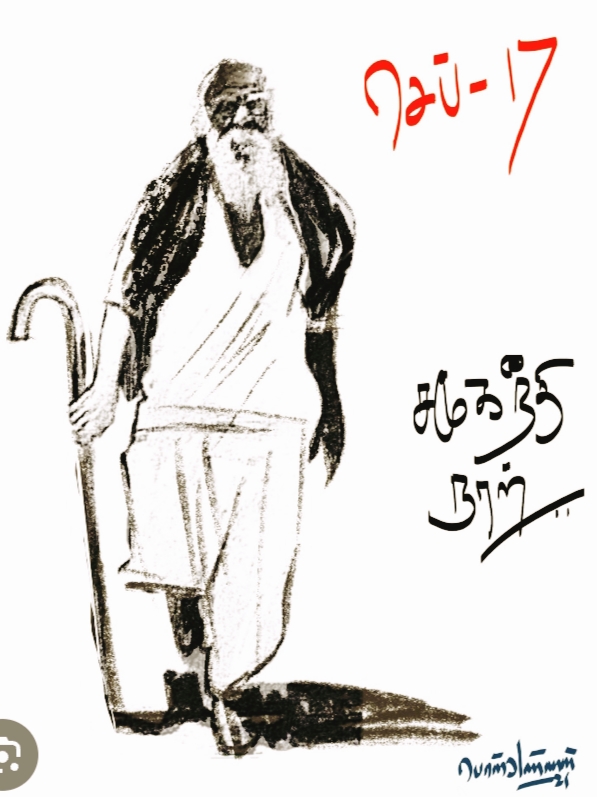
An Erode Venkatappa Ramasamy a.k.a Thandhai Periyar, was born in Erode, then a part of Coimbatore district of the Madras Presidency.
He was an Indian social activist and politician who started the Self-respect movement in 1926.
He was the founder of the Dravida Kazhagam (the Dravida Federation) and was known as the father of the Dravidian movement.
He rebelled against Brahmin dominance, gender and caste inequality in Tamilnadu.
EVeRa (as he’s known to many) promoted the principles of rationalism, self-respect, women’s rights and eradication of caste.
He opposed the exploitation and marginalization of the Dravidian people of South India and the imposition of what he considered Indo-Aryan domination.
The state of Tamilnadu celebrates his birthday on 17th September every year as Social Justice Day.
On 24 December 1973, Thandhai Periyar (the Father and the Elder for many) died at the age of 94.
But his ideals still stay fresh in the minds of people of Tamilnadu today.
He’s the one, I dare say, the most confident person I know.
 "சென்றிடுவீர் எட்டுத் திக்கும்"