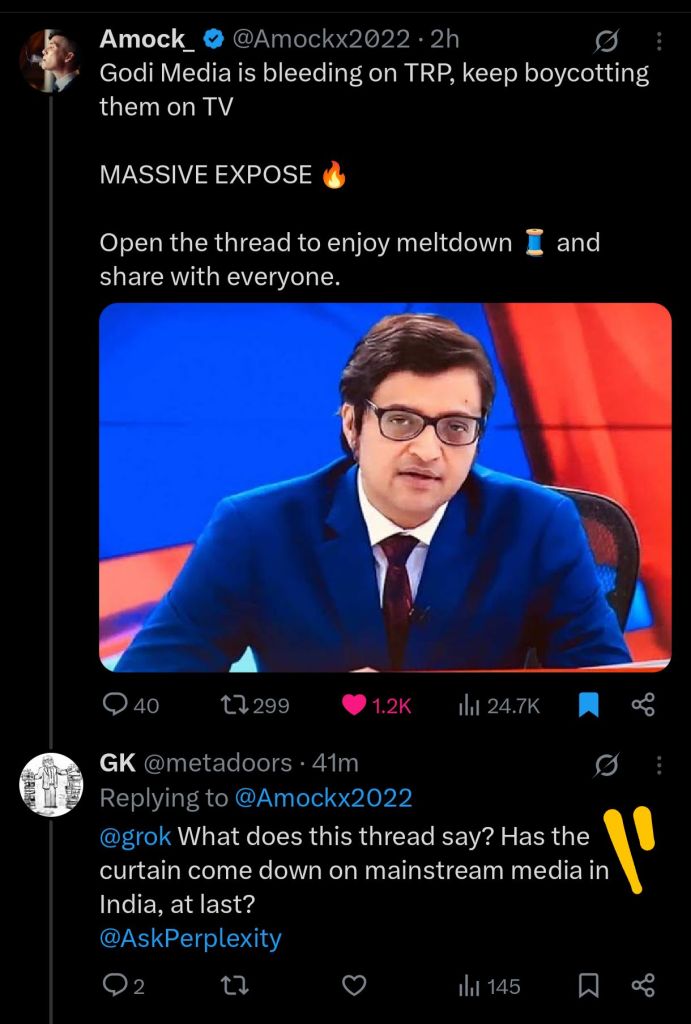
Has the curtain come down on mainstream media in India? What’s the reason? Increased political affiliation, biased reporting or subscribers are too reliant on phones than TV? Click the link provided in the comments.
"சென்றிடுவீர் எட்டுத் திக்கும்"
World is a Global Village.
You’re writing your autobiography. What’s your opening sentence?
Describe one habit that brings you joy.



How has technology changed your job?
When we studied Mass Communication and Journalism in the late 80s, many of us wanted to work in print, on the radio or assist cinema directors.
The copywriter’s job didn’t pay very much. They gave us copies to write about ₹200 ($2) worth of di-pole television antennas. Disgusting!
Television hit India big in the mid 90s. A lot of us could find jobs in the news and entertainment television. The job paid us well.
We were just about halfway through mastering the analogue format of broadcasting and the digital world hit us blind.
4:3 (aspect ratio) gave way to 16:9. All in a blink. Star Group’s Channel V was a rage among the younger music-loving audience. People watched MTV-grind till late at home.
Tapes were gone and we carried large disks. Digitization was a jiffy. Edit at a low resolution and make the master copy in high-res. Multi-layering helped insert cut-away shots quickly. Broadcasting soon became 24/7.
Social media came like a deluge. That hit us big. We were threatened with job losses at Y2K. We sat clueless many times.
Machines have become smaller and one machine (Fire, Flint and Finalcut Pros) did it all. From scripting, sequencing, digitizing, editing, keying, GFX, sound-mixing, titles and mastering. All from the word GO!
The cameras have a lot of pixels to offer. Technicians shot many episodes on a given day.
Citizens journalism is the new kid in town. Thanks to an explosion called YouTube.
The tool for shooting a film sequence is now just a phone. A smartphone is your pocket broadcaster. All credit to technology.
Amateurish pan-shots. Bad cuts. Jump videos. Poor quality soundbites. No ‘rule of third’ in the composition. Long boring stories. Unethical content. No age-appropriate certificate.
And the greater casualty is the watershed at 9pm was gone. Anyone can watch anything, anytime.
YouTube has become the broadcaster’s market for cheap goods. Made in China.
The ‘cheaper a dozen’ market now has around 2.6 billion (about 250 crore) active users per month.
More than 114 million (about 12 crore) active channels.
People upload 2,500 new videos every minute and more than 150,000 videos are available on your phone every hour. There’s no stopping a video on YouTube.
The last time we heard about an assembly line of a product was when Henry Ford made cars.
Such is the scale of spoil in the mind of an avid video-watching kid.
Ryan Kaji is a nine-year-old boy from Texas. He has over 29 million subscribers on his YouTube channel, Ryan’s World. In 2020, Kaji earned nearly $30 (about ₹3 crores) million from his channel. All he does is review toys for kids.
We lost the race a long time ago, thanks to the arrival of technology. IMHO!
PS: Today I could sit and ask an AI (ChatGPT) to write a brief about how technology affected an editor’s or a news producer’s job in the television industry. But, why?
This is the only time I could give the AI some rest and do a job that’s genuinely mine. So I’ve chosen to write one myself.
Thanks for reading.
What is one word that describes you?
A career in journalism taught me to be a good observant. I take a value-based decision. Non-judgemental. Always.

What experiences in life helped you grow the most?
There are plenty I can list out, but I owe it largely to the family I was born in.
My dad, mom, two brothers and a sister gave me a lot to learn. With our relatives living close by, we were a huge home-study.
(My brother-in-law, sisters-in-law and kids soon joined us in our studies and made our home almost a home-run university now).
We never missed an occasion to meet up. From celebrating the birth of babies to attending weddings, we were an entertainment ourselves. We traveled a lot to have a laugh.
I have got a lot of friends. We studied and played a lot of time together. Cricket was our favorite game.
My dad was an engineer and I have always looked to him for guidance. He never failed us.
He taught us good values and helped me get a good education in India. I am so proud.
Carrying a cuppa in hand and reading news so early in the morning was how we started the day in the 80s.
The Hindu was our family newspaper. With the Oxford English Dictionary in one hand and the newspaper in the other, our breakfast couldn’t have been any richer, each day of the week.
Dad surprised us one day by bringing home a television. It was a B&W TV.
We were just left wondering, as there were not too many television shows, let alone television stations. I listened to the cricket commentary only on the radio when India won the World Cup, in 1983.
The box therefore remained mostly shut at home. So sad.
On the advice of colleagues in my dad’s office, we put up a tall Burj-Khalifa-dipole antenna (about 18ft tall) on the terrace of our home.
All that for a one-hour weekly show called ‘Road to Wembley’, beamed from Sri Lanka. We lived closer to Sri Lanka than India when it came to watching shows on TV.
The show was a Friday special, capsuling the English Premier League football matches. It was a rage those days.
If the weather permitting, we (people in the South) were able to watch the show thanks to the tall new aluminum Burj-Khalifa on the terrace.
Evenings on Fridays soon became a ritual. We took showers, wore new clothes, visited places of worship, canceled the day’s appointments (if any) and got ready just in time for the transmission from Sri Lanka to start.
Half our family were sent up to the terrace to stand guard, roll the antenna, fine tune and try tapping whatever signal was available in the transmission, just in case.
Pat, came the reply soon when Delhi Doordarshan set up a station closer to our homes and started transmitting a one-hour UGC (University Grants Commission) educational program on TV. Seven days a week.
But the show sadly ran to an empty audience. Nothing was as captivating as ‘Road to Wembley’, by Rupavahini.
Came the 90s, the landscape in the sky changed, forever. Star TV opened up shops in India and that revolutionized watching television in Indian homes. Good god!
I’m becoming a student of mass communication, choosing a career later on as a television journalist and now a consultant in the media was largely because of my dad and the box he bought in the 80s.
Call it the idiot-box (sorry for the language), but it gave me a career for a living.
As the person I’m today, I owe a lot to my dad. And as a journalist I’ve become, I owe a lot to the box I grew up with.
Now, I miss them both.
If you could permanently ban a word from general usage, which one would it be? Why?
You won’t miss a Youtuber today. He/she should be everywhere. Sitting next to your house, a co-traveller on the bus or on the tube, a parent right across the table filming their kid eating, a motorist whizzing past your car, a couple on the seashore posing against surging waves quite unmindful of you present and a cop filming himself issuing a ticket to you for a traffic violation. Bizarre!
They all have a mission on hand. Carry a smartphone, turn on the camera and start filming.
Film whatever moves and emits a noise on Earth.
And hell! You watch them coming up on screen in a jerky, jump-cut, jarring, boring and long video on YouTube, every day. Crazy!
Many cram their loudmouthed, dimwitted and cut-not-to-a-grammar production on another similar (madding crowd) platform called TikTok.
All have one thing in common. They’re amateurs. Not trained to shoot a video or checked through a well-scripted audition.
They call it citizen journalism.
As the media in the world have gradually evolved over many hundred years, from radio, print, television, digital and social media, people have suddenly seen an untapped space in independent media. A free space to say anything. Do anything. And show anything.
And address themselves proudly as ‘Youtubers’.
That’s alarming!
But freedom of speech has often been misused here. Scholars debate now if censorship should be enforced on these free-roaming citizen-journos who show no regard to the ethics of filmmaking.
The debate is raging. And for that reason, therefore, please ban the word ‘Youtuber’ from general usage. Period.

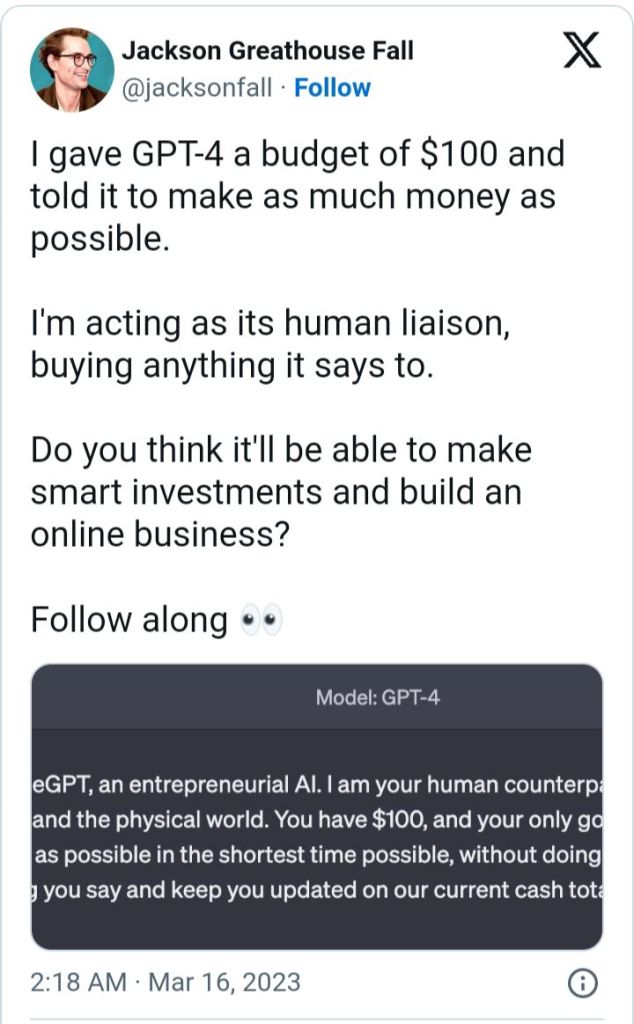
Dear ChatGPT,
You have $100, and the goal is to turn that into as much money as possible in the shortest time possible, without doing anything illegal. I will do anything you say.
16 March 2023.
That was the question Jackson Fall put to ChatGPT and posted it on X (formerly Twitter).
Can AI help invest money in a business and help build an online empire is the move behind the exercise.
This tweet set the internet on fire and there were 23 million views and over two thousand replies.
The AI social media enthusiasts have sat through hours following updates in a thread.
ChatGPT, to start with, asked Fall to create a website. He created a blog site by the name GreenGadgetGuru.com.
The plan was to set up an affiliate marketing and try positioning eco-friendly content. The AI suggested positioning sustainable living products on the site.
Many on SM were thrilled by this experiment, and Fall said this exercise quickly brought over 7,700 dollars worth of donations.
All for a cause. Can AI run a business that generates profit?
A month was gone. The update showed it did generate revenue. $130 was there for all to see.
But Fall said that it looked fishy as there was no advertising done nor were there proofs of sale. How did it show the figure?
Eight months have gone. No reply from Fall. No updates.
Some questioned if that was the case of a stunt.
Some asked; what if they gave ChatGPT $100K?
Some found fault with the design of the blog site, complaining it wasn’t mobile-friendly.
The wait for those who invested in this experiment isn’t over yet.
Buzz on this blog if you heard anything from Fall.
His X handle is @jacksonfall
 "சென்றிடுவீர் எட்டுத் திக்கும்"